Transrail Lighting is a four-decade-old, Mumbai-headquartered EPC contractor that designs, manufactures and builds power transmission & distribution infrastructure — lattice towers, monopoles and conductors made in its own plants, erected under its own project teams, in India and in roughly 58 countries abroad. A smaller civil-construction, railway-electrification and pole-and-lighting business sits alongside the core T&D franchise. The company listed on the NSE and BSE in December 2024; promoter family Ajanma Holdings still holds 71.12% of the equity, unchanged and unpledged through every quarter reported since.
FY26 (year ended March 2026) was the best year in the company's history on every headline number: revenue of ₹6,880 crore, operating profit of ₹941 crore at a 13.7% margin, and profit after tax of ₹404 crore — a 23% rise over FY25. Order book closed the year at ₹16,361 crore, up 12% year-on-year, and CRISIL upgraded the company's credit rating to AA-/Stable in August 2025 on the back of a strengthening balance sheet. None of this is in dispute.
What the market is reacting to is the quarter that followed. Q1 FY27 (April-June 2026) revenue grew just 5% year-on-year, against a 20-22% full-year growth target management had reaffirmed as recently as its May 2026 earnings call. The stock closed at ₹482 on 6 October 2026 — 37% below its own 52-week high and barely above its 52-week low — even as the order book, the capacity build-out and the credit profile all kept improving. That gap, between a company that is executing well by most measures and a share price that has stopped believing the growth number, is this report's starting point.
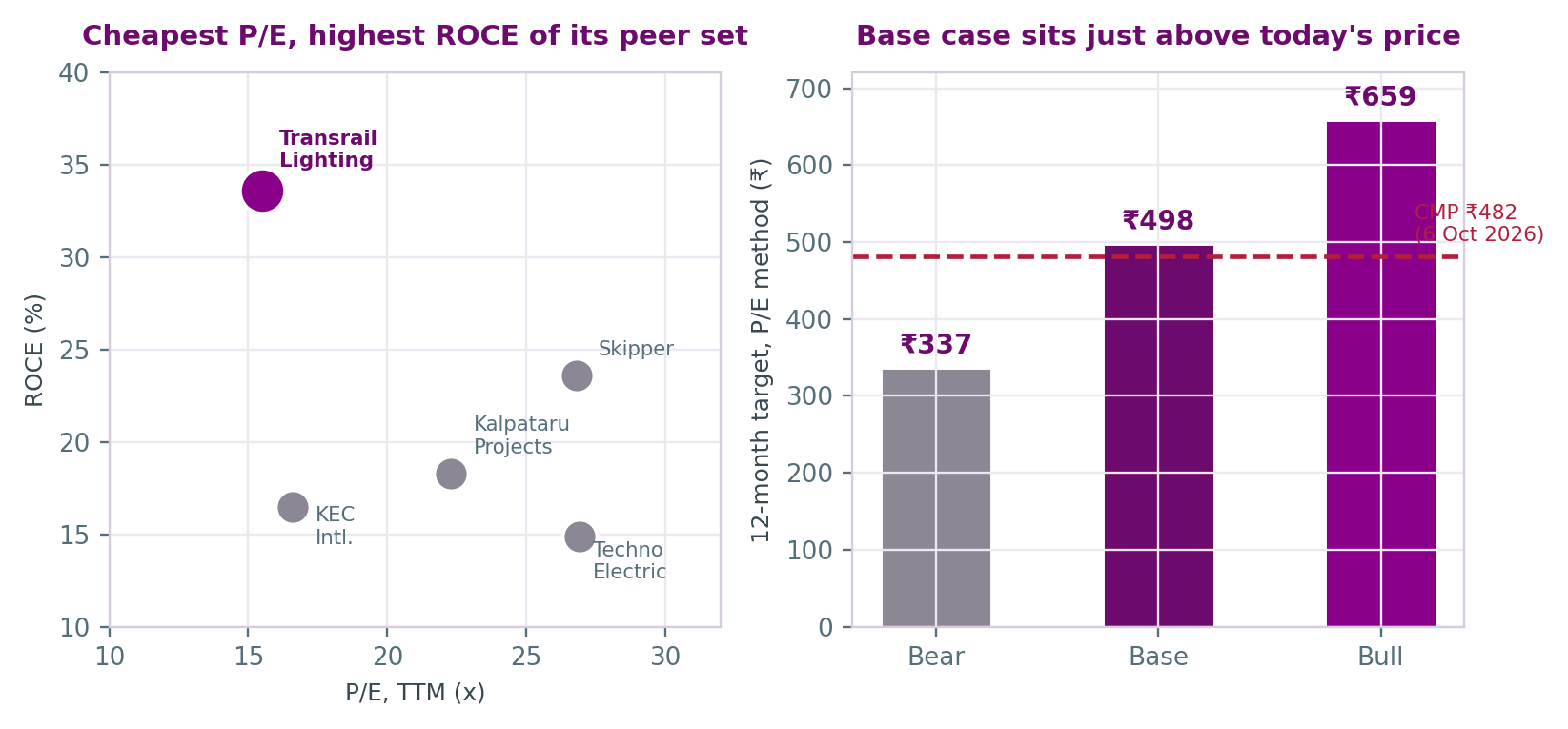
Net: HOLD. On capital efficiency and balance-sheet quality, Transrail is arguably the best-run company in its own peer group — the lowest P/E and the highest ROCE of the five listed Indian transmission EPC names we compared it against. But a stock this cheap usually has a reason, and here the reason is concrete and recent: a guidance-versus-delivery gap that has not yet been resolved, a ₹600 crore equity raise that has shareholder approval but no price, and a cluster of smaller disclosure and litigation items that argue for patience rather than conviction either way.
Transrail listed on the NSE and BSE mainboard in December 2024 and is therefore subject to the full SEBI LODR regime — Regulations 17 through 27 on board composition, committee structure and related-party disclosure — with no SME exemption to fall back on. Rated NCDs and commercial paper outstanding bring an additional layer of debt-market disclosure. Roughly 40% of the order book sits outside India, which means country-specific regulatory and currency considerations (Bangladesh, the Middle East, Australia) run alongside the domestic LODR regime, though the available sources did not detail how those are managed internally.
Promoter shareholding has not moved an inch — 71.12% in every quarter disclosed since listing — and a formal regulatory filing in April 2026 confirmed zero pledge on those shares, a cleaner signal than the steady post-IPO drift seen at some peers. The company paid a dividend (₹3 interim plus ₹2 final for FY26) even while funding a capacity doubling largely from internal accrual and a modest term loan. Two rating actions from CRISIL inside eighteen months — reaffirmation and then an upgrade to AA- in August 2025 — required sustained financial transparency to an external agency, not just to the exchanges. And when a contractual dispute over container-detention charges on a Nigeria project was escalated by a logistics vendor into an insolvency petition at the NCLT, the tribunal dismissed it on jurisdictional grounds — the company successfully defended what the adjudicating authority itself characterised as a dispute that had no business being an insolvency filing.
Digambar Bagde holds the Chairman's seat in an executive capacity rather than as an independent, non-executive chair — a common structure among Indian promoter-led companies, but one that concentrates authority rather than separating it. The statutory-auditor picture is not fully clear from public sources: shareholders approved G.M. Kapadia & Co. as joint statutory auditor at the September 2026 AGM, but whether this sits alongside the incumbent, Nayan Parikh and Co., or replaces it, could not be confirmed. No itemised related-party-transaction disclosure was found in the sources reviewed, which is worth noting given that the promoter group's holding company, Ajanma Holdings, sits at the centre of the ownership structure. Independent director Dilawar Singh ceased to hold office on 13 September 2026 with no stated reason available in public filings reviewed. Separately, institutional ownership has shifted composition over four quarters — DII holding fell from 14.08% to 6.51% while FII holding rose only to 2.49% — a pattern that could reflect benign index rebalancing or a more cautious institutional read on the stock; the available sources did not settle which.
Two, both disclosed, neither disqualifying at current scale. Following a search-and-seizure operation by the Income Tax Department at Transrail's offices and factories between 24 and 28 March 2026, the company subsequently received a GST demand of ₹8.23 crore and an associated penalty of ₹42.74 crore — a penalty equal to roughly 10.6% of FY26's net profit. The company has stated its intent to appeal; the matter is unresolved as of this report. Separately, BSE and NSE issued a warning in April 2026 for a disclosure that described a senior employee's termination as a resignation — a LODR disclosure-accuracy breach rather than a financial one, but a breach nonetheless.
The outcome of the GST appeal; the pricing, size and timing of the ₹600 crore QIP; written clarification of the joint-versus-replacement auditor question; resolution of an arbitration dispute with Uttar Pradesh discom Madhyanchal Vidyut Vitran Nigam Ltd, whose financial materiality could not be established from available filings; and the status of a proposed acquisition of part of Gammon Engineers and Contractors' bridges-tunnels-hydropower business, which remains unconfirmed as approved, pending or withdrawn.
Adequate, with disclosed matters that call for attentiveness rather than alarm. Nothing found in this research rises to a structural governance failure, and the ownership picture — a stable, unpledged promoter stake, dividends paid through a capex cycle, voluntary rating-agency transparency — supports reasonable trust. But three threads are live and unresolved at once: a tax penalty under appeal, a pending and unpriced equity raise, and an auditor-transition question that public filings have not fully answered. None of them, alone, would change this report's conclusion. Together, they are a reasonable argument for waiting for clarity before adding conviction either way.
Transrail carries no live, current institutional price target we could verify — the one identifiable brokerage call (Axis Direct, BUY, ₹560) dates to April 2025 and predates more than a year of capacity expansion, order wins and the FY27 guidance-versus-delivery gap this report leads with. In the absence of current sell-side coverage, we built our own forward estimate directly from management's own stated FY27 guidance, rather than from a brokerage consensus that does not exist.
We start from FY26 actuals (revenue ₹6,880cr, EBITDA margin 13.7%, net margin 5.9%) and apply three scenarios for FY27, scaling net margin off FY26's own EBITDA-to-net-profit conversion ratio (42.9%) — a simplifying assumption, stated explicitly, not a disclosed figure. A target P/E is then applied to the resulting EPS, informed by where Transrail trades today (15.5x) and where its peers trade (16.6x-26.9x, average ~23x) — without assuming full convergence to the peer average, given the unresolved guidance gap.
| Scenario | Revenue growth | EBITDA margin | EPS (₹)* | Target P/E | Target price | Upside/(downside) |
|---|---|---|---|---|---|---|
| Bear | 18% | 10.0% | 25.9 | 13.0x | ₹337 | -30.1% |
| Base | 21% | 11.0% | 29.3 | 17.0x | ₹498 | +3.3% |
| Bull | 22% | 11.7% | 31.4 | 21.0x | ₹659 | +36.7% |
*EPS derived on the current share count of ~13.44 crore shares; the pending ₹600cr QIP would dilute this further once priced, which this table does not attempt to anticipate given its terms are undisclosed. Bear case uses revenue growth below management's guided 20-22% range, reflecting the Q1 FY27 print; base case takes management's own 21% guidance midpoint at face value; bull case assumes the top of guided revenue growth alongside Q1 FY27's actual (rather than guided) EBITDA margin of 11.7%. Target P/E of 17.0x for the base case represents a modest re-rating from the current 15.5x — well short of the ~23x peer average — reflecting that the guidance gap is unresolved, not that it has been dismissed.
Cross-check (second method): Transrail's current enterprise value (market cap ₹6,477cr plus net debt ~₹204cr) of ~₹6,681cr implies an EV/EBITDA of roughly 7.1x on FY26 actual EBITDA — we could not source a comparable EV/EBITDA figure for any of the four peers, so this check is against Transrail's own current multiple, not a peer benchmark. Applying a modestly re-rated 9.0x to the base-case FY27E EBITDA of ₹916cr gives an enterprise value of ₹8,244cr; subtracting the same ~₹204cr net debt gives an equity value of ~₹8,040cr, or ₹598 per share (+24.1%) — higher than the P/E method's base case. Averaging the two methods' base cases (₹498 and ₹598) gives ₹548, which we round to this report's ₹550 target. The ₹100-per-share gap between the two methods is itself informative: it is roughly the size of the uncertainty this report has tried to name explicitly throughout, rather than resolve by picking one number and presenting it as precise.
Upgrade triggers: H2 FY27 revenue growth tracking back toward the guided 20-22% range; the ₹600 crore QIP pricing at a level that does not meaningfully dilute per-share value; resolution of the GST appeal without material incremental liability. Downgrade triggers: a further cut to FY27 revenue or margin guidance; a QIP priced at a materially dilutive level; an adverse outcome on the GST appeal beyond the ₹42.74 crore already provided for; confirmation that the Q1 FY27 shortfall reflects demand softness rather than the bidding-to-award timing lag management has cited.
| FY24 | FY25 | FY26 | Q1 FY27 | |
|---|---|---|---|---|
| Revenue | 4,077 | 5,308 | 6,880 | 1,736 |
| EBITDA | 559 | 776 | 941* | 203 |
| Net profit (PAT) | 233 | 329 | 404* | 108 |
| EPS (₹) | 18.81 | 24.48 | 30.06 | 8.04 |
| Order book (year/quarter-end) | — | — | 16,361 | 16,035 |
| Net debt | — | — | ~204 | — |
| *FY26 EBITDA and PAT are reported inconsistently across sources: this table uses screener.in's figures (₹941cr EBITDA, ₹404cr PAT). A second screener.in-derived pull gave ₹881cr EBITDA and ₹411.63cr PAT for the same year, and separate trade-press coverage cited ₹820cr EBITDA and ₹421cr PAT. The spread could not be reconciled from secondary sources in the time available for this report; a reader needing an exact figure should refer to Transrail's own FY26 exchange filing or annual report rather than any single aggregator. | ||||
| Selected ratios | FY26 / current |
|---|---|
| ROE | 20% (FY26) |
| ROCE | 33.6% (current) / 35% (CRISIL, FY25) |
| Net debt / EBITDA | ~0.2x (FY26) |
| Debtor days (screener) / receivable days (CRISIL) | ~92 days / ~270 days |
| Dividend per share (FY26) | ₹5.00 (₹3 interim + ₹2 final) |
| Credit rating | CRISIL AA-/Stable (long-term), A1+ (short-term) — upgraded Aug 2025 |
Balance sheet and cash-flow statements are not reproduced in full here; the detail available from secondary sources did not extend to segment-level capital-employed figures, and a full restatement risks implying more precision than the underlying disclosure supports. Readers needing the complete financial statements should refer to Transrail Lighting's own annual report and exchange filings. Source: screener.in, CRISIL Ratings (rationale dated 4 March 2026 and 5 August 2025), company investor presentations, and exchange-filing coverage via business-standard.com, tndindia.com and multibagg.ai — all accessed 7 October 2026 unless otherwise dated in the text above.
Dart Consultants is a market intelligence and technology service provider, not a SEBI-registered Investment Adviser or Research Analyst. This report is educational material only — not investment advice, and not a recommendation to buy or sell any stock. The HOLD rating above is an educational device for summarising public information and one house's own valuation construction, not a regulated recommendation. Several figures in this report — most significantly the FY27 earnings scenarios in the Valuation section — are Dart Consultants' own indicative estimates built from management's public guidance, not figures disclosed by the company or forecast by any brokerage; they should be treated as one house's reasoning, not a certainty. Where source figures disagreed (noted explicitly throughout, including in the Financial summary), we have shown the disagreement rather than silently selecting one number. Readers should independently verify any figure before relying on it. The analyst(s) preparing this report hold no position in, and have no banking, advisory or brokerage relationship with, Transrail Lighting Ltd, and have received no compensation from the company.
| 12-month target | ₹550 |
| CMP (6 Oct 2026) | ₹482 |
| Implied upside | +14.1% |
| Rating | HOLD |
| Market cap | ₹6,477 cr |
| P/E (TTM) | 15.5x |
| 52-week range | ₹400.65 – ₹766.80 |
| Book value/share | ~₹170 |
| Dividend (FY26) | ₹5/share* |
| Net debt | ~₹204 cr |
| Promoter (Ajanma Holdings & family) | 71.12% |
| FII | 2.49% |
| DII | 6.51% |
| Public | 19.87% |
| FY25 | FY26 | Q1 FY27 | |
|---|---|---|---|
| Revenue | 5,308 | 6,880 | 1,736 |
| EBITDA | 776 | 941† | 203 |
| PAT | 329 | 404† | 108 |